 |
|
| Home Free Chapters Browse Book Store Industry Blog Contact Us | |
BPMN Edición digital en español View Larger Image If you prefer to use your Amazon.com account, click
below:
Best BPMN Books Bundle
|
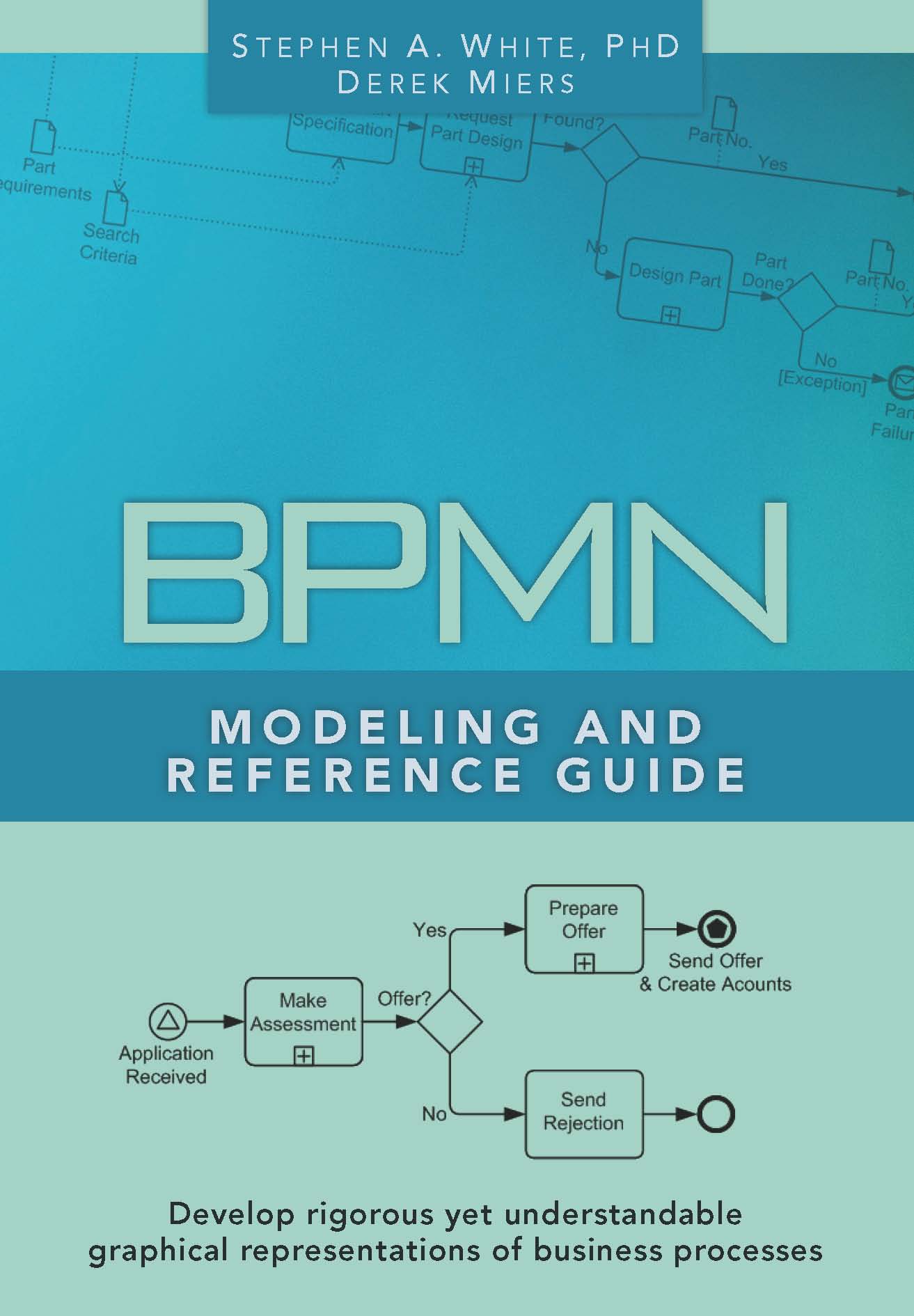
BPMN Modeling and Reference Guide
|
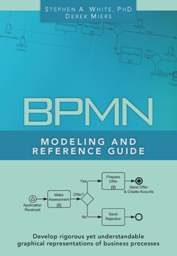



Two Best Sellers - One Special Price! Total Retail Price: $114.95 You get two complete books in one bundle of 10MB zipped PDFs - the Reference Guide introduces you to BPMN and the new Handbook gives you the latest information on BPMN 2.0. Download both books now. (10mb zipped PDF) |
** LIMITED TIME SPECIAL OFFER** When you buy the new BPMN 2.0 Handbook SECOND Edition (Digital) for only $69.95, you get the BPMN Modeling and Reference Guide Digital Edition (including Q&A tutorial) for free. Download here for the Special TWO BEST BPMN BOOKS BUNDLE.
|
Sample Chapters:
Full Table of Contents, Full Chapter 4 and half of Chapter 5. (27 pages PDF).
Select your version:
 PRINT EDITION (ships from our warehouse within 24 hours)
DIGITAL EDITION (download book immediately 4MB PDF)
DIGITAL EDITION (INCLUDES FREE BPMN Templates, 6MB) NEW!
BPMN Edición digital en español (new!) $49.95
The only BPMN book in Spanish now in both Digital and Print Editions.
Edición impresa en español (Precio: $49.95) Comprar en Amazon.com
BPMN Edición digital en español WITH FREE BPMN TEMPLATES $49.95
_________________________________
New! FREE BPMN HandsOn Modeling Templates included when you buy the Digital Edition. The modeling templates are for non-technical process simulation. Print onto magnetic sheets or self-sticking paper, move around and discuss BEFORE you use your modeling software. Template Value $199. View What's in the Templates.
_________________________________
Authors:
 |
 |
| Stephen A. White, PhD (workgroup chair of the BPMN.org committee and creator of the BPMN specification) | Derek Miers (industry analyst with Forresters and BPMN expert, previous co-chair of BPMI.org) |

The most popular book ever published on BPMN. If you or your organization is using, or thinking of using, BPMN, this is the absolute best guide you could buy.
Currently in use by over 95,657 individuals, corporations, universities and colleges worldwide, with readership growing daily.
"It is an easy, yet excellent, introduction to BPMN."
"...much needed reference for our industry! Your book is well written, easy to read and present the BPMN concepts in an easy to understand way.."
"If you are interested in a condensed BPMN overview for both business and IT people - this is the book for you. If you are looking for the best BPMN book around - this is also the book for you. "
"... by far one of the best/easiest introductions to BPMN or any other topics I have seen in awhile."
More reader feedback below (scroll down)
Sample Chapters: Full Table of Contents, Full Chapter 4 and half of Chapter 5. (27 pages PDF).
Buy Now! Select your book...
- PRINT EDITION (we ship worldwide within 24 hours, no delay)
- DIGITAL EDITION (download complete book immediately in 4MB PDF format)
- BPMN Edición digital en español (new!) $49.95
The only BPMN book in Spanish.
Product Details
- Perfect Paperback: 226 pages
- Publisher: Future Strategies Inc., Lighthouse Pt, FL
- Language: English
- ISBN-13: 978-0977752720
Foreword:
Dr. Richard Mark Soley, Object Management Group, USA
Dr. Angel Luis Diaz, Websphere Business Process
Management
IBM Software Group USA
Afterword:
Dr. Michael zur Muehlen, Stevens Institute of Technology, USA
Develop rigorous yet understandable graphical representations of business processes.
Business Process Modeling Notation (BPMN) is a standard, graphical modeling representation for business processes. It provides an easy to use, flow-charting notation that is independent of the implementation environment. An underlying rigor supports the notation—facilitating the translation of business level models into executable models that BPM Suites and workflow engines can understand. Over recent years, BPMN has been widely adopted by Business Process Management (BPM) related products—both the Business Process Analysis and Modeling tool vendors and the BPM Suites.
This book is for business users and process modeling practitioners alike. Part I provides an easily understood introduction to the key components of BPMN (put forward in a user-friendly fashion). Starting off with simple models, it progresses into more sophisticated patterns. Exercises help cement comprehension and understanding (with answers available online). Part II provides a detailed and authoritative reference on the precise semantics and capabilities of the standard.
About the Authors:
Renowned experts Stephen White (IBM) and Derek Miers (BPM Focus) have been involved in the development of the BPMN standard since the early days of BPMI.org. As Work Group chair and Specification Editor since its inception, Stephen White was instrumental in creating the BPMN standard and is now guiding its continuing refinement at the OMG. Derek Miers has played a leading role in the BPMN space—first as Co-Chair of BPMI.org and more recently within the OMG. He delivers training and consulting worldwide around BPMN, Process Architecture and BPM in general.
- PRINT EDITION -- Buy
Ships from our warehouse within 24 hours, to anywhere worldwide
- DIGITAL EDITION -- Buy (NEW!)
Zipped file: 4MB
Digital Edition contains full color graphics and hyperlinks from Table of Contents for easy navigation.
BONUS: Zipped file contains additional document with Exercises and Answers from the book. - ADDITIONAL BONUS: Free Hands-on Printable BPMN Templates
- BPMN Edición digital en español (NEW!)
Precio: $49.95 Comprar
Table of Contents
Introduction
This book provides a modeling guide and reference for the features of BPMN Version 1.1.
In Part I, we describe a little of business drivers associated for process modeling, aligning that with the history of the Business Process Modeling Notation (BPMN™), standard and discussing expected future developments. We go on to talk about processes and modeling in general to set up and position some of the issues and challenges for BPMN modelers.
We then present the BPMN modeling approach using a progressive scenario that unfolds for the reader. As we elaborate on each new aspect of the scenario, we feature the functionality of BPMN that supports the desired behavior. Rather than attempting to explain fully each concept in detail, this part of the book sticks to the fundamental principles, referring the reader to the relevant Reference Section for more detail (i.e., Part II of this book).
The intention is to enable the reader to understand how to apply BPMN against a real world scenario. Moreover, the approach taken here introduces each set of functionality in a non-threatening way, allowing the reader to develop their understanding at their own pace. Throughout this part of the book, we introduce exercises for the reader to complete, helping them cement their comprehension and establish a fundamental level of skill. The answers to those exercises will be made available online (as part of the online training that complements this book).
Part II presents a detailed reference section that covers the precise semantics of the BPMN standard, explaining them and the process behavior that results.
For the casual modeler, Part I will provide enough to get up and going. Over time, we expect that you will dip into Part II (the detailed reference) section to familiarize yourself with the precise functionality of the Notation.
Book Structure
The book is organized into 13 main chapters followed by Appendices, a Prologue, Glossary and Index:
Part I
Chapter 1—“Introduction”
Chapter 2—“The Importance of Modeling” introduces process modeling in general, highlighting how it supports communication and understanding amongst people. It briefly covers how Process Models can aid communication and drive work through the enterprise.
Chapter 3—“Processes” provides a quick introduction to BPMN Process concepts, covering Orchestration, Choreography and Collaboration concepts.
Chapter 4—“Modeling Approaches & Architecture” introduces some of the potential approaches to modeling with BPMN.
Chapter 5—“A Scenario-Based Introduction to BPMN” provides an easy to follow introduction to BPMN modeling. It starts with a simple, easily recognized situation and then builds up on that base, slowly introducing and explaining BPMN functionality to support the evolving behavioral complexity.
Part II
Chapter 6—BPMN Reference Section Introduction provides a short preface, explaining the tokens that we use to demonstrate the behavior associated with each BPMN element.
Chapter 7 —Activities explores Tasks, Sub-Processes and Process Levels in general. It then goes on to discuss the special issues affecting Sub-Processes.
Chapter 8 —Events provides detailed explanations of all the Start, Intermediate and End Events. It goes through each one in turn describing the behavior of each element.
Chapter 9 —Gateways investigates the role of Gateways in BPMN modeling (points where control is required to split and merge paths), going through the precise behavior associated with each type.
Chapter 10 —Swimlanes sets out the precise semantics and rules associated with Pools and Lanes.
Chapter 11 —Artifacts discusses how to represent Data, Documents and other things not directly covered with the core process flow diagram objects.
Chapter 12 —Connectors explores the meaning associated with Sequence Flow, Message Flow and Annotations.
Chapter 13 —Advanced Concepts provides explanations of The Life-Cycle of an Activity , Compensation and Transactions , and Ad Hoc Processes .
Appendices provide a more detailed examination of:
- Process Execution Environments (BPM Suites and Workflow).
- Techniques for Process Architecture—a short discussion of some of the available approaches.
- A collection of BPMN best practices.
BPMN Directions—discusses the likely direction of the BPMN specification, exploring some of the functionality expected in BPMN 2.0 and subsequent revisions.
Afterword provided by Prof. Michael zur Muehlin discusses some of the uses of Process Models and, through the use of BPMN, how to avoid the mistakes of the past.
Glossary and Index
feedback here: leave a comment, ask a question... read chapter 1 in full
- PRINT EDITION -- Buy
Ships within 24 hours, anywhere worldwide
- BPMN Edición digital en español
Precio: $49.95 Comprar - DIGITAL EDITION -- Buy (NEW!)
Zipped file: 4MB
Digital Edition contains full color graphics and hyperlinks from Table of Contents for easy navigation.
BONUS: Zipped file contains additional document with Exercises and Answers from the book.
Praise for BPMN Modeling and Reference Guide:

 I think the BPMN Modeling and Reference Guide is by far one of the best/easiest introductions to BPMN or any other topics I have seen in awhile. Your book captures the very essence of what needs to be understood in a concise manner.
Everette Jones, E-Systems Architectures, Inc.
 …Kudos to you guys, because you have created a much needed reference for our industry! Your book is well written, easy to read and present the BPMN concepts in an easy to understand way that is accessible to the laymen while allowing experts to better understand some on the sometime not so clear intentions that are in the spec.
Denis Gagne, Trisotech
From Amazon.com
 Great Reference Guide October 29, 2008
This is a very readable book that is, as the title indicates, a reference guide. It is an easy, yet excellent, introduction to BPMN. Nevertheless, as a reference guide, be advised that it does not contain anything on methodology.
 Good book, October 30, 2008
As being one of the BPMN gurus, Stephen White, wrote in fact, a good book about the theme. The book is objective, and has a good explanation level.
Personally, I recommend it, for the rookie or intermediary levels.
Easy to read and understand approach, October 2, 2008
This text reads like a novel. One example is used in Part I of the learning approach. It starts with a high-level diagram and proceeds with follow-up detail diagrams - to use a cliche - it's like peeling an onion. At each level, new concepts and associated symbols are introduced with page references to indepth discussions later in the text.
I really like this learning approach and found the text easy to read and understand. Highly recommended.
 The authoritative guide to BPMN, March 3, 2009
By Steinar Carlsen (Norway) - See all my reviews
I, and Computas in Norway, have been involved with BPMN since the early days in 2003 / 2004 leading to the release of BPMN 1.0 from BPMI. For years, there was no book about BPMN, except for the specification itself. Over the last year, BPMN books have started to appear - and among them is the authoritative guide to BPMN; "BPMN Modeling and Reference Guide" by Stephen A. White - who has been the editor of the standard over the years - and Derek Miers - one of the few European BPM Gurus.
The most amazing thing about this book is its (lack of) thickness - the authors have accomplished to write this authoritative guide in only 221 pages. The introductory part - "Understanding BPMN" is only 46 easily read pages; with lots of nice examples covering BPMN 1.1 modeling style using signal events etc.
If you are interested in a condensed BPMN overview for both business and IT people - this is the book for you.
If you are looking for the best BPMN book around - this is also the book for you.
If you are interested in reading several hundreds of pages about BPMN - I would start with this book, next complement it with the specification itself; available from OMG's website.
Use your Amazon.com account to get BPMN 2.0 Handbook
What does that BPM acronym mean? Simply type in any term and get the quick answer |
||
Only $9.97 each |
|
Business Transformation Series

~ Business and Dynamic Change
~ BPM Everywhere
~ Thriving on Adaptability
~ Empowering Knowledge Workers
~ iBPMS - Intelligent BPM Systems
~ Human Centric BPM
~ Social BPM
~ Taming the Unpredictable
~ BPMN 2.0 Handbook 2nd Edition
Retail $49.95

* Thriving on Adaptability
*
Passports to Success in BPM
* Moving the Goalposts
* Using BPM for Competitive Advantage
* Innovation, Implementation and Impact
* Successful Process Implementation
* Delivering BPM Excellence
* Taming the Unpredictable
* Customer-Centric Organization
* How Knowledge Workers Get Things Done
* Delivering Competitive Advantage
* Understanding and Using BPM
____________________
Could your case study be an Award-winner?
Get recognition for your visions and your team's achievments.

WfMC Awards for Excellence in BPM and Workflow

WfMC Awards for Excellence in Case Management